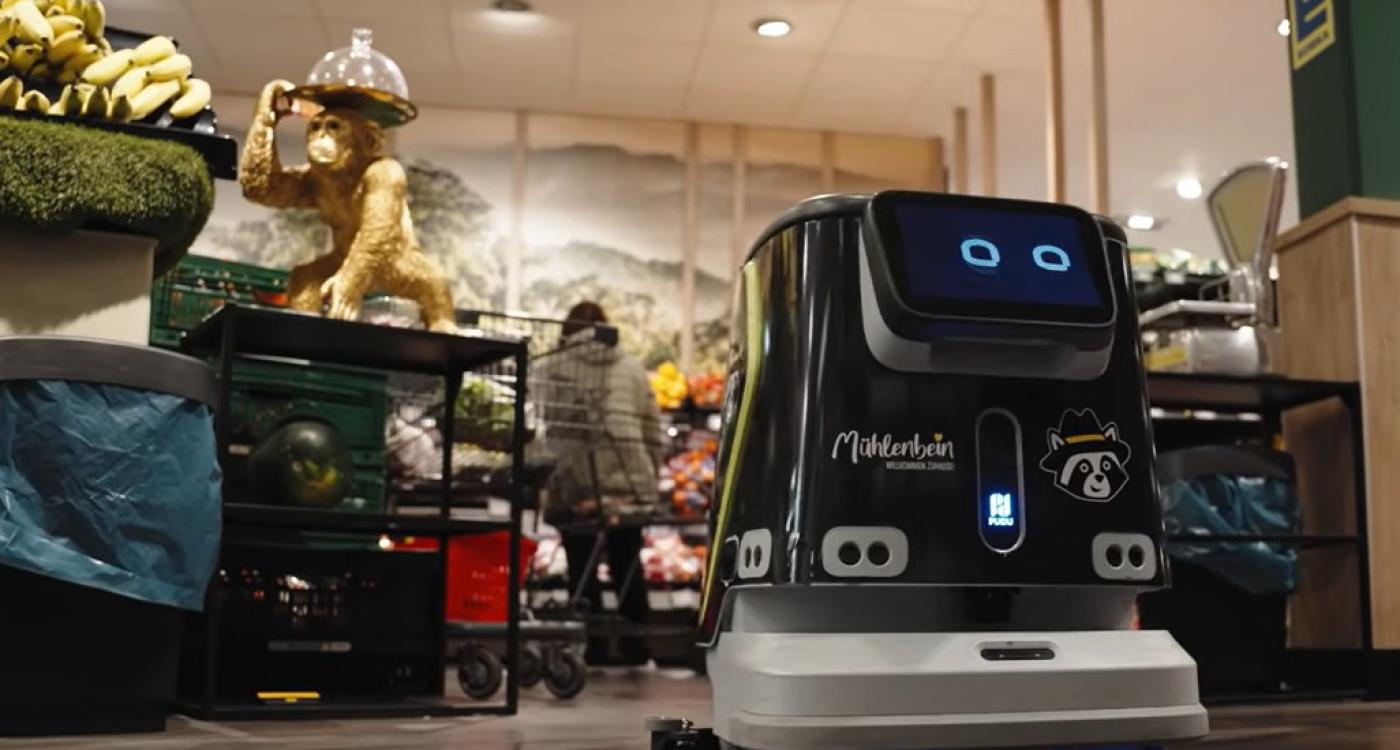
When Josef Mühlenbein took over the EDEKA store in Kassel, almost all staff stayed on board – except the cleaner. He then began looking into technical solutions and opted for a cleaning robot from Future Machines. Around two and a half years later, the store has already swapped the device for a larger model.
The Trigger: When the Cleaner Is Missing
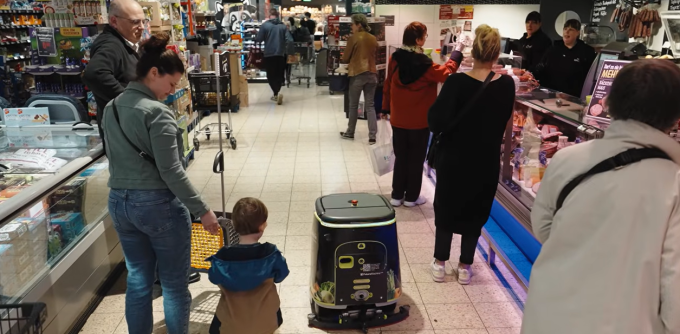
The starting point was not easy, but “what works at home must surely work in the store too”, Mühlenbein recalls. The challenge: the store dates from 1988 and, by its own account, is the first EDEKA Neukauf store in Kassel. It covers just under 1,800 square metres, and a drinks store connected via the car park is part of it. In Mühlenbein’s view, cleaning robots were hardly widespread at the time. Interest among customers was correspondingly high, especially among the youngest: “It’s an incredible experience for the kids”, says Mühlenbein.
In Daily Operation: Fixed Routines, Flexible Routes
The main floor area in the store is pre-programmed. On a timer, the robot starts several times a day – in the morning, at midday, in the afternoon and in the evening. In the morning and evening it also takes in the checkout zone and the front-end area, as long as nobody is standing there yet. In between, it has to stay flexible: if many customers are in the way, it picks other areas and, for example, heads for the frozen-food section first rather than the fruit and vegetables.
Does it also clean at night? Technically that would be no problem, Mühlenbein confirms. In practice, however, it is more difficult – at least in the Kassel store. “We have several fire doors, which raises the question: who opens them? And who tells the alarm system that the thing is allowed to drive?”, he says. Because the doors may not be left open, some areas would remain uncleaned at night anyway.
Speaking of everyday use: nobody has to worry about the water. The device is connected to a fresh-water and a waste-water supply. “When it notices it’s full, it drives over there”, says Mühlenbein. The robot then empties the tank, rinses it and refills it with fresh water. “There’s no smell.”
Even so, it doesn’t work entirely without people. If a jar of pickles falls to the floor, the spot can’t be targeted to the metre on the large map. Staff then step in: “I want to operate it manually, press a little button and then I can push it.” An electric motor assists. The route across the car park to the drinks store is also manual work. The device could manage it alone, but Mühlenbein doesn’t want to risk it with cars around. So someone pushes the robot over and starts it there. “That’s essentially the only thing anyone has to do with it.”
How the Principle Works in General
Julian Käfer and Maximilian Mandel of Future Machines explain what using a cleaning robot typically looks like. Their key figures:
- Operating time: Depending on the size of the store, a device is on the move for around three hours a day.
- Rhythm: In most stores, the robot starts once early in the morning, then returns to its station and charges there. In the afternoon it goes out again. In Kassel, the device runs more often.
- Coverage: As a rule, it manages the entire floor area within opening hours.
Käfer puts the technology into context: “At its core, the robot is a wet-cleaning machine as we know them, but it works automatically.” It doesn’t manage corners and edges, he says, “but for stores, using it is still a noticeable relief”. By his estimate, the device takes over 80 to 90 percent of the cleaning of the main floor area.
Full Service: The Robot Runs, Others Take Care of It
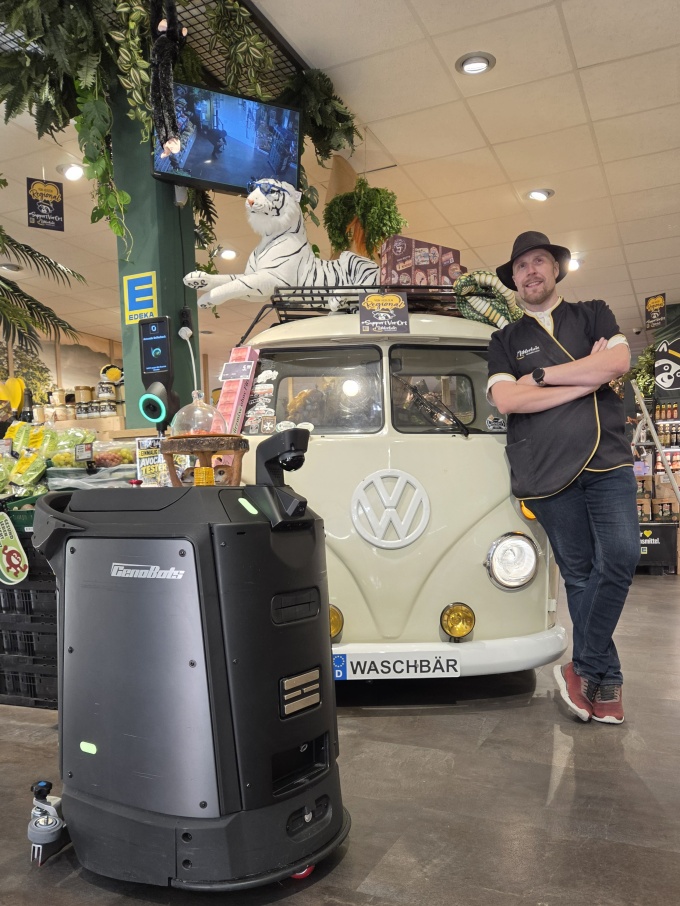
When Josef Mühlenbein talks about the robot, it is rarely about technology, but about peace of mind. “My core business isn’t looking after the cleaning robot. I see it a bit like a car: it should run and work.” “For that, Future Machines offers me the package that suits me best, with everything I need.”
The technician comes twice a week. “As a rule, we don’t even notice he’s there”, says Mühlenbein. The man knows where everything is, does his work and leaves. Only if he notices something does he speak to the team.
That puts the store well above what Mandel describes as the industry standard: “Many come about four times a year with two to four sets of wear parts. That includes a visual inspection and replacing the squeegee blade or brushes.” Anything beyond that often costs extra, travel included.
According to its own account, Future Machines takes a different approach: at least one visit per week, during which the team replaces parts, cleans the robot and carries out preventive maintenance. According to Mandel, a visit takes between one and one and a half hours and is scheduled for times when the robot isn’t running anyway. “Store colleagues shouldn’t become robotics experts”, he says. “We take care of the robot, the owners take care of their store.”
Much can also be resolved remotely. Future Machines has developed its own platform for this that collects error messages. In many cases it reacts “before the customer even notices”, says Mandel. He gives three examples:
- Gets stuck: If the robot hangs during an update, the team restarts it remotely.
- Declines slowly: If the device reports a fault with the brush roller, technicians look at the voltage readings. If they keep dropping over a longer period, the ball bearing is probably rusting. It is then cleaned or replaced.
- Drops suddenly: If the readings fall from one second to the next, something has got caught in the roller, such as a band.
Mühlenbein reaches the team via WhatsApp. “Quite simple: a photo. I have a problem. Please deal with it when you get a chance.” Requests such as changing the cleaning logic are handled the same way. When a motor once overheated and the responsible technician was ill, the team sent a video with instructions. “I could work with that, and the problem was fixed within a few minutes.”
The provider also admits that technology can fail. “You simply have to be realistic”, says Käfer. If in doubt, the device is replaced; with express shipping, the machine can arrive the next day. This has already proved itself in Kassel: one robot failed completely because of an internal fault, and the new model was on site quickly. For Mühlenbein, that means: “I know I can always rely on it running.”
What It Costs: Renting Instead of Buying
In Kassel, the robot has replaced one position. “It saves me at least the staff costs for a cleaner, which I no longer need”, says Mühlenbein. The team spends perhaps ten minutes a day on the device, “maybe 10 percent at most of what was there before”.
The store did not buy the robot but rents it. According to Mandel, that is the normal case: “The vast majority of customers, I’d say 90 to 95 percent, are on a rental model with us.” The hardware costs are spread over the term so that they don’t arrive “all in one go”, but together with the service as a monthly invoice, “just as you would know it from staff or a service provider”. Mühlenbein does not name a price. When switching to the new device, the terms were adjusted to the model. His comparison: at a car dealership, an ID.3 costs something different from an ID.7 or a Porsche, “but it’s all within a bearable range, and you can talk about it.”
When a Cleaning Robot Pays Off (Benchmark Figures from Future Machines)
Cleaning performance | Humans and robots each clean just over 500 m² per hour |
Staff costs | Employees at least around 18 euros, service providers often around 30 euros |
Robot | Around 30 euros a day depending on model and floor area, sometimes less, sometimes more |
Term | 36 to 60 months, usually 36 or 48 |
Area | From about 800 m², roughly break-even with in-house staff, and profitable sooner with an external service provider; from about 1,000 m² “really fun”, according to Mandel |
At just under 1,800 square metres, the store in Kassel is above that.