Automation: An overview of shuttles, AMRs and goods-to-man systems
From full-range retailers to urban stores: how automated warehouses are redefining retail logistics
Report by Katja Laska15.04.2026
Anyone walking through a large supermarket - past the cheese counter, the non-food aisle with books and household goods, and the international and regional produce - inevitably asks themselves: how does the warehouse behind the scenes work? How is a product range of this size sorted, scheduled and picked every day without causing any delays on the shop floor?
The answer – increasingly common these days, and not just for online giants like Amazon or Zalando - is: thanks to automation. The global market for autonomous mobile robots (AMR) was already worth between 3.1 and 5.3 billion US dollars in 2025 and is growing by 17 to 22 per cent annually. The message for the retail sector: technologies that for years seemed reserved solely for large corporations are now also becoming available to medium-sized and smaller retailers.
What does it all actually mean?
Five terms dominate the debate and can be confused:
Term
Brief explanation
Typical application
Shuttle system
Automated vehicles transport containers in high-density racking systems
Central warehouses, full-range retailers
AMR
Autonomously navigating robots move freely through the warehouse
Flexible operations, omnichannel
Goods to man
The goods are automatically transported to the picker – not the other way round
E-Commerce, e-Grocery
Cube storage / Auto store
Compact grid of stacked containers, with robots moving above them
Urban stores, limited space
AI fleet control
Software coordinates all systems simultaneously in real time
Complex multi-system environments
Trend 1: Shuttle systems – high-density storage in confined spaces
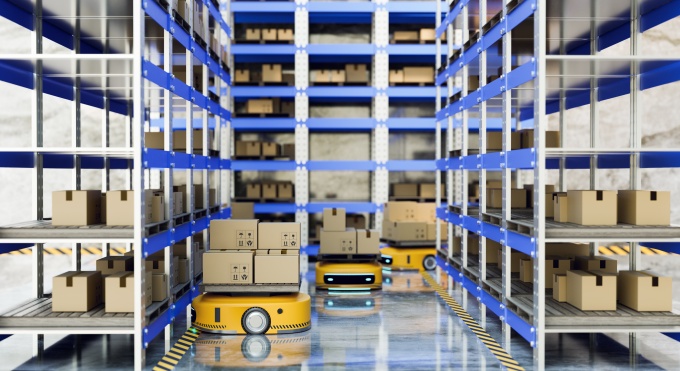
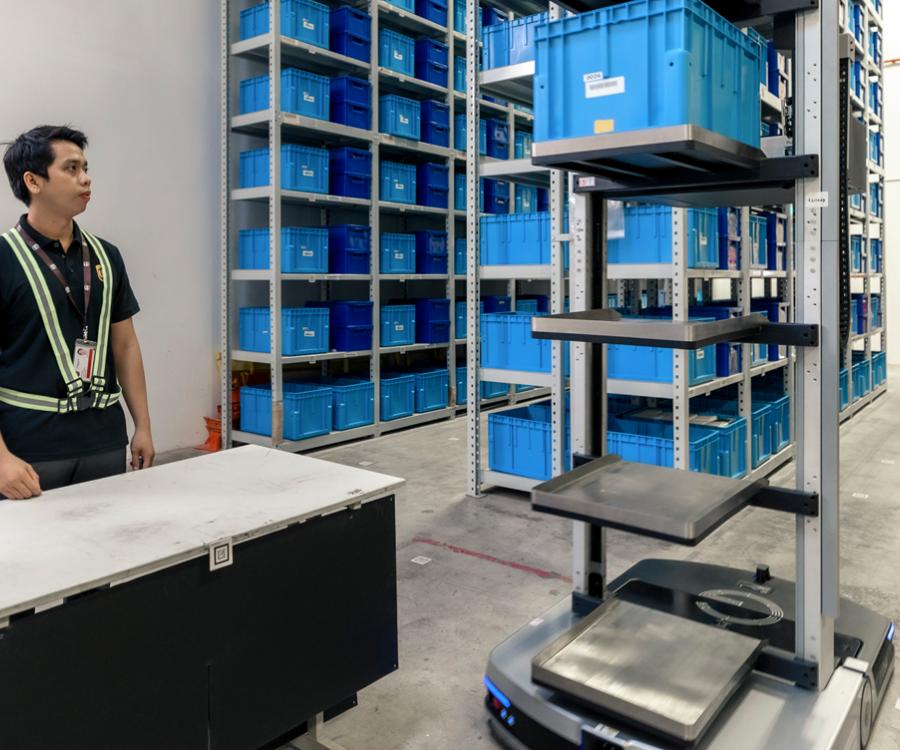
Shuttle systems are among the best-known technologies in warehouse automation. Small, fast vehicles move automatically through tightly packed racks and deliver containers directly to the picking station. The global market was worth around 4.57 billion US dollars in 2024 and is set to grow to 12 billion US dollars by 2032. At LogiMAT 2026 in Stuttgart, several suppliers presented advanced, honeycomb-based systems - more flexible and space-saving than their predecessors.
For retailers: High initial investment, ROI horizon of 4 to 7 years. Economically viable for medium-sized businesses and above.
Trend 2: AMRs - Flexibility as an advantage
Autonomous Mobile Robots are the most dynamic segment of the market. Unlike fixed-installation systems, AMRs navigate freely through the warehouse, avoid obstacles and can be integrated without the need for structural alterations. By 2035, the AMR market is expected to grow to 25 billion US dollars. Many large warehouses are, of course, already capitalising on these technological advantages. According to Zebra Technologies’ Warehousing Vision Study, 70 per cent of warehouse operators are under concrete pressure to modernise, and 63 per cent are planning investments within the next five years.
For retailers: Flexible entry possible, moderate investment. Also suitable for SMEs.
Trend 3: Goods-to-Man - Less walking, faster picking
The Goods-to-Man principle turns the traditional picking process on its head: instead of staff walking through the warehouse, the goods come to them. Automated systems bring what is needed. The benefits: significantly higher picking rates, fewer errors and a reduced workload for staff. This principle is now particularly in demand in the e-grocery sector, where same-day delivery is becoming increasingly important.
For retailers: Medium to high investment, but economically viable once a certain order volume is reached.
Source: envato elements
Trend 4: AutoStore & Cube Storage - Maximum storage in a minimum of space
Every single metre is put to use here, as plastic bins are stacked on top of one another in a cube-shaped grid, whilst robots move along a track above them, bringing the required containers to the top. Storage capacity can therefore be doubled or even tripled within the same floor space. This is a particularly good solution for urban retailers with limited storage space.
For retailers: Compact entry-level systems available. Scalable from SMEs to enterprise-level.
Trend 5: AI-powered fleet management - the warehouse’s nervous system
Here, connectivity is the key, as it enables all systems to function at their best. AI-powered fleet management coordinates shuttles, AMRs and goods-to-man stations in real time – forecasting order peaks, optimising routes and planning maintenance proactively. When using such solutions, AI must be considered an integral part of the system architecture. The second part of our logistics cluster explores how this works in detail and which providers are shaping the market.
What is worthwhile for whom?
Small (< 500 m²)
Medium (500–3.000 m²)
Large (> 3.000 m²)
AMRs
✅ Entry-level option
✅ Recommended
✅ Established
Goods-to-Man
⚠️ Only suitable for high volumes
✅ Practical
✅ Standard
Shuttle systems
❌ Usually too complex
⚠️ Individual cases
✅ Ideal
AutoStore/Cube
✅ Compact, suitable for SMEs
✅ Flexibly scalable
✅ Proven
AI fleet control
⚠️ Only in combination
✅ Future-proof
✅ Indispensable
Summary & Outlook
The technologies are in place, and the barriers to entry are falling. At present, it still appears to be a strategic option, but in a few years’ time it could become a necessity for retailers in their day-to-day operations.
Germany leads the rollout for the European account-to-account payment system, as Wero pushes to become a genuine alternative to US-based payment giants
An EDEKA store in Kassel relies on a rented robot instead of a cleaner, switches models after around two years and takes stock of service, costs and data protection.
This website uses cookies to give our readers the best website experience. Please refer to our privacy policy to find out how we use cookies and how you can edit your preferences.